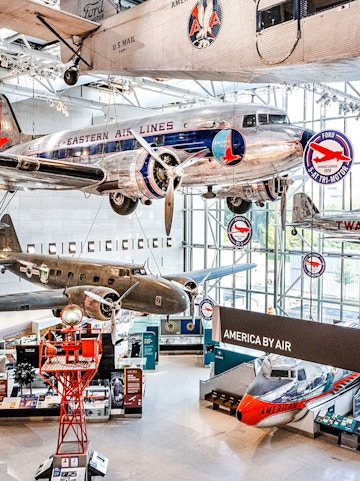
From the Space Race to the first flight in human history, the Smithsonian's National Air and Space Museum is filled with exhibits and artifacts that offer an insight into the world of aviation, including its history, key milestones, and more. Guided tours offer a deeper insight into this world, with access to all permanent exhibits, a curated tour with an expert, and a chance to explore the universe of flight around the world and into space.
What to expect on your guided tour of the Smithsonian's National Air and Space Museum
1/6
Trace the story of flight from early aviation to space exploration
Explore milestones that changed how we travel and understand the universe, from the Wright brothers’ first powered aircraft to modern spacecraft, on your guided tour, and learn more about the remarkable journey of human flight.
See iconic aircrafts and spacecrafts up close
The museum is home to some of the most famous flying machines in history. A guided tour ensures you don’t miss these highlights while also introducing lesser-known but equally fascinating exhibits.
Gain insights into science and engineering breakthroughs
Your guide explains the science behind flight, from aerodynamics to rocket propulsion, in a way that’s easy to understand. Learn how engineers and astronauts overcame challenges to push the boundaries of exploration, transforming your museum visit into a richer learning experience.
Navigate the museum efficiently with a curated route
The museum features multiple galleries filled with aircraft, models, and interactive displays. A guided tour helps you move through the most important sections without feeling overwhelmed.
Upgrade to a private tour for a personalized experience
Choose a private tour to enjoy a more customized and flexible itinerary. Whether you’re interested in military aviation, space missions, or the future of flight, your guide can tailor the experience accordingly.
An ideal experience for curious minds of all ages
This tour is perfect for aviation enthusiasts, space lovers, families, and first-time visitors to Washington DC. Children and adults alike will find something to spark their curiosity, turning a museum visit into an inspiring journey through the history of flight.
Significance of the Smithsonian's National Air and Space Museum
Home to the world’s largest collection of aviation and space artifacts: The Smithsonian National Air and Space Museum houses one of the most extensive collections of aircraft, spacecraft, and related objects in the world. These artifacts document humanity’s journey from early flight experiments to modern space exploration.
Preserving milestones in the history of flight: The museum safeguards iconic vehicles like the Wright Flyer and spacecraft from landmark missions. These objects represent pivotal breakthroughs that transformed transportation, warfare, and global connectivity.
A center for scientific education and inspiration: The museum plays a key role in making complex topics like aerodynamics, astrophysics, and engineering accessible to the public.
Reflecting global innovation and technological progress: The museum’s collections demonstrate how advancements in aviation and space technology have shaped the modern world. From commercial air travel to satellite communication, these innovations have transformed how people live and connect.
Documenting the cultural impact of flight and space travel: Beyond science, the museum explores how aviation and space exploration have influenced popular culture, politics, and global imagination.
Part of the Smithsonian’s mission to expand knowledge: As part of the Smithsonian Institution, the museum contributes to research, preservation, and education on a global scale. Its collections support ongoing studies in aerospace history and technology.
Highlights at the Smithsonian's National Air and Space Museum
The Wright Flyer (1903)
The original Wright Flyer marks the first successful powered flight in history. This pioneering aircraft represents the moment humans first took controlled flight, changing transportation forever.
Know before you go
Opening hours: 10am to 5:30pm, daily
Closed on: Christmas Day (December 25)
Guided tour duration: 2.5 hours
Address: 650 Jefferson Dr SW, Washington, DC 20004, United States | Find on Maps
Closest Subway stations:
Smithsonian: Connects 3 out of 6 lines in DC: Blue, Orange, and Silver (0.3 miles)
Archives-Navy Memorial-Penn Quarter: Connects 2 out of 6 lines in DC: Green and Yellow (0.3 miles)
Closest bus stop: Independence St Ave & 6th St (5 mins)
First aid: Basic first aid support is available on-site, and museum staff can assist visitors in locating further medical assistance if needed.
Wi-Fi: Complimentary Wi-Fi is provided throughout the museum for visitors.
Time to explore after the guided tour: After the guided tour ends, you can continue exploring the exhibits at your own pace at the museum.
Mobility aids permitted: Visitors may use mobility aids such as canes, walkers, wheelchairs, and similar devices throughout the museum.
Accessible routes: Elevators, ramps, and step-free pathways connect major galleries and public spaces, making navigation easier for all visitors.
Accessible restrooms and entrances: Accessible entrances and designated restrooms are available across the Smithsonian museum buildings.
Stroller accessibility: Strollers are allowed inside the museum, making visits more convenient for families with young children.
Service animals allowed: Registered service animals are permitted under ADA regulations; emotional support, therapy, comfort, or companion animals are not recognized as service animals under these guidelines.
Wheelchair access by tour type: Wheelchair accessibility is available for self-guided and private tours, while small-group guided tours are not wheelchair accessible.
Sensory aids: The museum offers assistive resources for visitors with sensory sensitivities and for those with visual or hearing impairments.
Security screening: Entry to the museum requires passing through a security screening, which includes metal detectors and may involve additional bag checks.
Outside food policy: Outside food items are not allowed in the Smithsonian's National Air and Space Museum.
Late arrival policy: Timed-entry tours are rarely rescheduled if visitors miss their scheduled slot, so arriving on time is strongly recommended.
Photography equipment restrictions: Selfie sticks, tripods, and monopods are not allowed inside the museum.
No weapons or sharp objects: Weapons and sharp objects of any kind are strictly prohibited within the building.
No demonstration materials: Demonstration items such as placards, banners, aerosol containers, and signs are not permitted inside the museum.
No pets: Pets are not allowed inside the museum, except for registered service animals.
Arrive early for timed entry and security checks: Entry to the Smithsonian National Air and Space Museum requires timed-entry passes and security screening. Arriving 15-20 minutes early helps you avoid delays and ensures you meet your guide on time.
Look up and around: Some of the most iconic aircraft are suspended from the ceiling or displayed above eye level. Take time to look up during the tour so you don’t miss key artifacts your guide points out.
Take note of exhibits you want to revisit later: The tour covers major highlights efficiently, but you may want more time at certain displays like the Apollo 11 Command Module Columbia. Make a mental note or snap a quick photo of exhibit names to return after the tour.
Wear comfortable shoes for extended walking and standing: Even with a structured route, the tour involves moving through large galleries and standing during explanations. Comfortable footwear will help you stay focused and enjoy the experience.
Ask questions about science and missions: Guides often share fascinating insights into aerodynamics, space missions, and engineering breakthroughs. Asking questions can make complex topics easier to understand and more engaging.
Frequently asked questions about the Smithsonian's National Air and Space Museum tickets
Admission to the Smithsonian National Air and Space Museum is free as part of the Smithsonian Institution. Guided tour tickets cover the guide’s expertise and curated experience, not general entry.
Your guided tour is a timed-entry tour, but if you plan on visiting for self-guided exploration, timed-entry reservations are required due to capacity limits.
Guided tours last around 2.5 hours. This allows enough time to see key exhibits while leaving room to explore more on your own afterward.
Tours typically include iconic artifacts such as the Wright Flyer and the Apollo 11 Command Module Columbia, along with major aviation and space galleries. The exact itinerary may vary depending on availability and crowd conditions.
Yes, visitors are welcome to remain in the museum and continue exploring after the tour concludes. This is a great opportunity to revisit favorite exhibits or explore areas not covered during the tour.
Yes, a private tour upgrade is available, offering a flexible itinerary and the choice to personalize your experience focusing on specific interests such as space missions, aircraft design, or the history of flight. Private tours are also wheelchair accessible.
Yes, the museum is highly engaging for children, especially those interested in planes, rockets, and space. Guides often tailor explanations to make the experience interactive and accessible for younger visitors.
A guided tour helps you navigate the museum efficiently while providing expert insights into complex topics like aviation engineering and space exploration. It ensures you see the most important highlights without feeling overwhelmed by the size of the museum.