Quick Information
Plan your visitIs Museum of the Bible worth visiting?
You step in from the street and the scale hits first: bronze doors the height of a townhouse, a bright stone atrium, and a ceiling that glows overhead with scenes drawn from scripture. Inside, the museum feels less like a traditional gallery and more like a sequence of stages, screens, and artifact rooms, with enough quiet corners to slow the pace between the bigger immersive moments.
It was built to show the Bible not only as a religious text, but as a historical object that shaped law, language, art, and public life. That wider ambition matters because the visit works best when you treat it as a cultural museum with faith-inflected storytelling, not only as a devotional stop.
The payoff is range. In one visit, you can move from ancient manuscripts to interactive galleries and come away understanding how one text traveled across centuries, languages, and empires. Families, first-time visitors, and curious museum-goers usually leave feeling they got both context and spectacle.
Skip it if you want a strictly secular, debate-heavy history museum or dislike multimedia exhibits and timed add-ons.
What to see at Museum of the Bible?
Grand Hall and Gutenberg Gates
Start with the 40-foot bronze entrance doors and the soaring hall beyond. The Jerusalem-stone atrium and 140-foot illuminated ceiling set the museum’s tone before you reach the ticketed galleries.
History of the Bible galleries
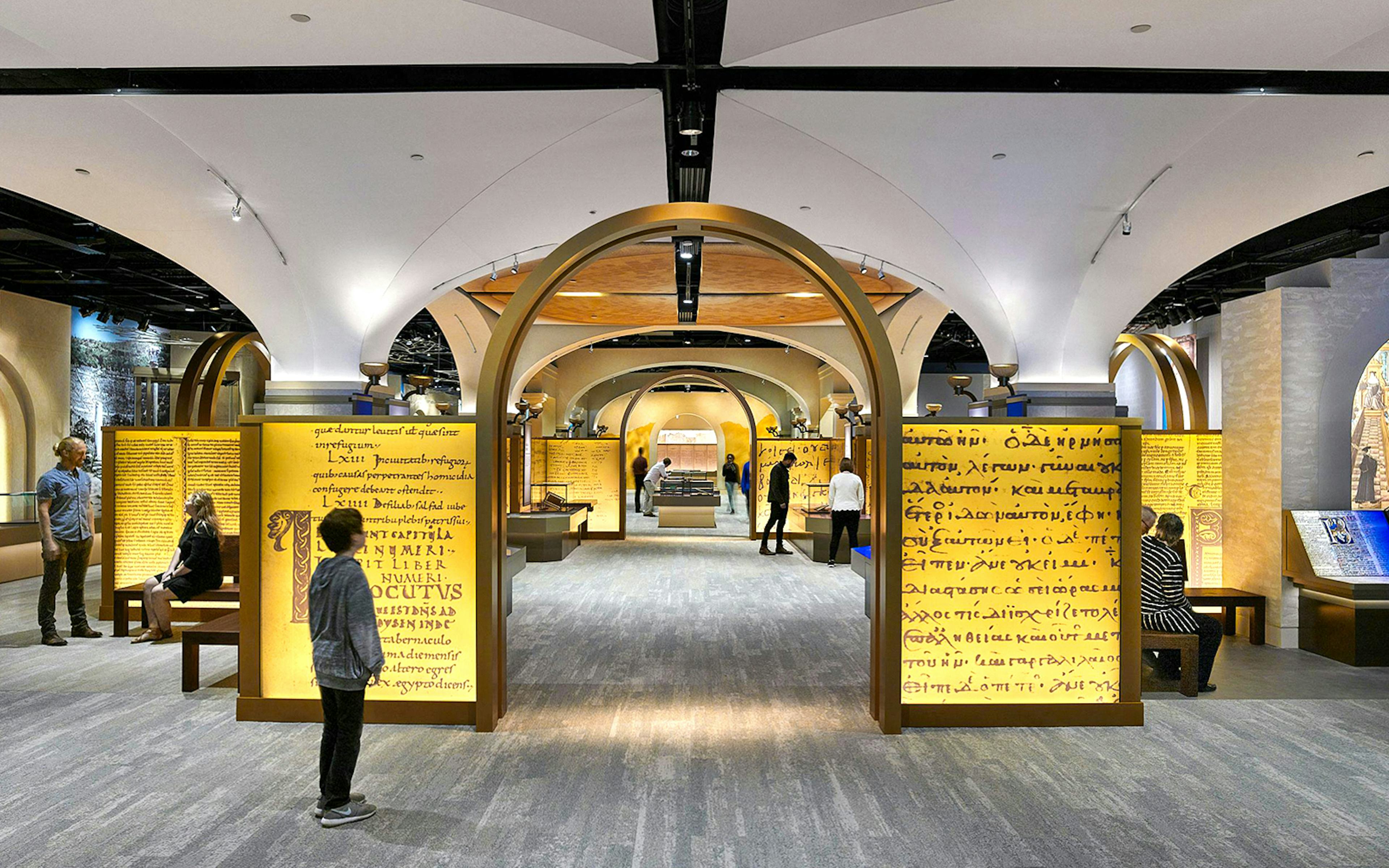
These rooms trace how biblical texts were copied, translated, preserved, and printed. Expect manuscripts, scrolls, and early editions that reward a slower pass rather than a quick sweep.
The Narrative of the Bible
This section turns major biblical stories into staged environments and multimedia scenes. It is one of the museum’s most accessible galleries for first-time visitors because it explains plot, setting, and characters clearly.
Impact of the Bible
On Floor 2, this gallery follows the Bible into music, art, literature, law, and public life. It is especially strong for visitors who care less about devotion and more about cultural influence.
Washington Revelations
This 6-minute motion ride connects Washington landmarks with biblical language and symbolism. It is not part of the standard gallery flow, so reserve a timed slot if you want it; popular weekend times go quickly.
All Creation Sings
Set on B1, this immersive show uses light, sound, and large-format visuals to explore worship across time. It is often treated as a separate experience, so check availability before building your route around it.
Children’s interactive areas
Courageous Pages and HISTORIES give younger visitors a break from reading-heavy galleries. Families usually appreciate these midway through the visit, when kids have had enough artifacts and need something more hands-on.
Temporary exhibitions
Leave time for the rotating show spaces, which often host focused exhibitions that change the feel of the visit. These are the best reason to return, even if you have already seen the permanent galleries.
How to explore Museum of the Bible
How much time to spend?
Budget 2–3 hours for the core museum, and closer to 4 if you add Washington Revelations, All Creation Sings, lunch, or linger in the artifact galleries. If you are short on time, 90 minutes is enough for the Grand Hall, one permanent gallery, and one immersive experience.
Best visit order
Start at the main entrance and Grand Hall, where the gates and ceiling orient you to the museum’s scale. Then move through the permanent galleries before screens and timed add-ons break your focus. Save Floor 2’s Impact of the Bible and Washington Revelations for later, then finish on B1 with All Creation Sings if you have a ticket.
Must-see highlights
Must-see: Grand Hall, one artifact-rich History of the Bible gallery, Impact of the Bible, and Washington Revelations if high-tech exhibits appeal to you. Optional: All Creation Sings, children’s zones, and the temporary exhibition spaces, which can add 30–60 minutes depending on queues and interest.
Worth adding nearby
The museum sits a short walk from the National Mall, so it pairs easily with the Smithsonian museums, the Capitol area, or an afternoon monument walk. Add at least 1.5–2 hours if you plan to combine it with another major museum.
Guided or self-paced?
Self-paced works well here because the signage and multimedia do a lot of the interpretation for you. A guided visit is worth it if you want sharper historical context, discussion, or help separating artifact history from faith presentation. If you mainly want the galleries, the ride, and the family spaces, you will do just fine on your own.
Brief history of the Museum of the Bible
- 2017: Museum of the Bible opens in Washington, DC, in a 430,000-square-foot building two blocks from the National Mall, dedicated to the Bible’s history, narrative, and impact.
- 2018: Nearly 1 million visitors arrive in the first year, placing the museum quickly among Washington’s major paid attractions.
- 2019: Annual attendance reaches about 1 million again, confirming strong demand beyond opening-year curiosity.
- 2020: Pandemic closures sharply reduce visitation and interrupt the museum’s momentum.
- 2020s: The museum expands immersive programming, including Washington Revelations and All Creation Sings, alongside rotating exhibitions.
- Today: Museum of the Bible operates as a large public museum blending artifacts, interactive media, and educational galleries in one visit.
Architecture & design of the Museum of the Bible
The building announces itself before the exhibits do. You enter through 40-foot bronze Gutenberg Gates and into a tall Grand Hall lined with Jerusalem stone, where the space feels more civic than devotional, broad, bright, and deliberately ceremonial. Look up early: the 140-foot illuminated ceiling washes the hall with biblical scenes and turns the first few minutes into part of the exhibition. Inside the galleries, the design shifts from monumental to immersive. Artifact cases, projection rooms, touchscreens, and theater-style environments are arranged to keep you moving between quiet study and sensory spectacle. It is less about ornate detailing than about sequence: arrival, orientation, immersion, and reflection. Even if the subject matter is not personal for you, the building is designed to make the experience feel consequential.
Who built it?
Museum of the Bible opened in 2017 as a large public-facing institution dedicated to the Bible’s story and influence. Rather than foregrounding a single star architect in the visitor experience, the project emphasizes symbolic materials and civic scale, bronze gates, Jerusalem stone, and immersive interiors that frame the collection dramatically.
How the museum balances faith and scholarship
The museum works best if you arrive knowing it is neither a neutral academic archive nor a purely devotional space. Its galleries are structured around history, narrative, and cultural impact, but the tone is generally faith-friendly and more interpretive than argumentative. That mix is exactly why some visitors find it compelling, and others find it selective. If you are comfortable reading the museum as a perspective-driven cultural institution, one that uses scholarship, technology, and storytelling together, you will likely get more from the visit than if you expect a debate-heavy museum of religion.
Frequently asked questions about Museum of the Bible
Yes. The Grand Hall is free to the public, so you can step inside to see the bronze Gutenberg Gates and illuminated ceiling even if you are not touring the paid galleries that day.
No. Washington Revelations is usually treated as a separate timed add-on, so do not assume it is bundled into standard admission. If the ride matters to you, reserve that slot before building the rest of your visit.
Usually, yes. All Creation Sings is presented as a distinct immersive experience rather than a gallery you casually pass through. Availability can change by date, so it is smart to confirm access when planning the rest of your museum route.
Yes, if you are interested in how texts shape history, art, politics, and culture. The museum’s tone is faith-friendly, but many of its strongest rooms are about transmission, translation, and influence rather than personal belief.
Smithsonian and L’Enfant Plaza are the two most useful Metro options. Both put you within an easy walk, and L’Enfant Plaza can be especially handy if you are combining the museum with other stops around the National Mall.
Yes. The museum is wheelchair-accessible, with elevators serving all floors, and the broad gallery layouts make navigation easier than in many older Washington museums. Strollers are generally manageable too, especially in the larger permanent exhibition areas.
Not entirely. The museum has been part of the wider conversation around fragment authenticity, and several pieces once associated with the Dead Sea Scrolls were later identified as modern forgeries. The broader collection still includes substantial manuscript and Bible-history material.
Yes. The museum has on-site dining, including the Milk + Honey Café, which makes it practical to stay for a longer visit. If you are watching costs, eating before you arrive is usually the cheaper option.